
 English
 Pусский
 한국어
한국어 Tiếng Việt

电机铁芯制造工艺
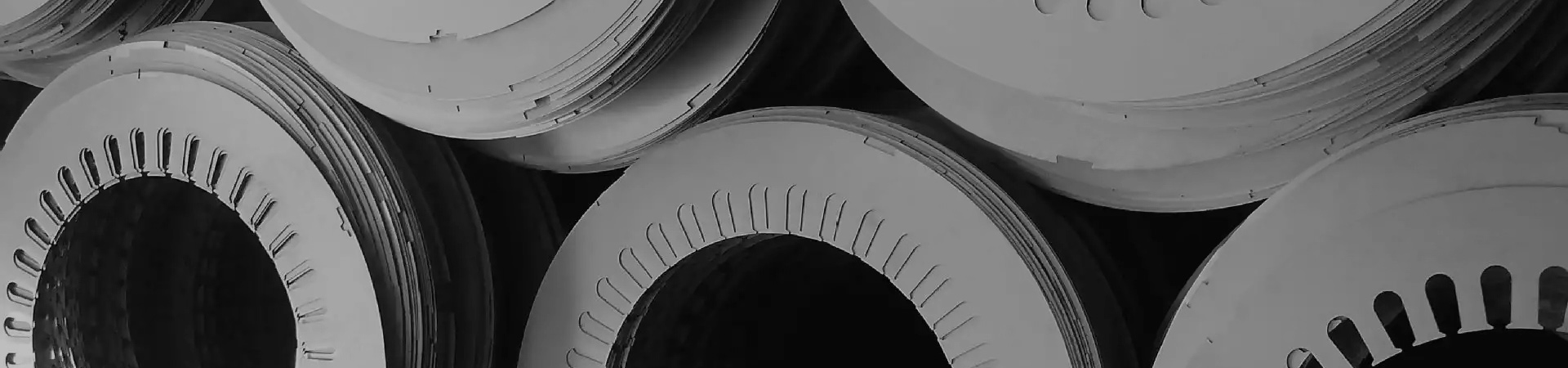
Motor Core Manufacturing Process The manufacturing of motor cores is a critical process in producing efficient electric motors, which are widely used in various industries, including automotive, industrial machinery, and consumer electronics. The motor core, typically made from laminated electrical steel, serves as the stator or rotor and is responsible for generating and transferring magnetic flux. The production process involves several key steps, including material selection, stamping, stacking, heat treatment, and assembly. 1. Material Selection The process begins with selecting high-quality electrical steel, often silicon steel, due to its excellent magnetic properties and low core loss. The steel is supplied in coils or sheets, with thicknesses ranging from 0.1 mm to 0.5 mm, depending on the motor’s performance requirements. 2. Blanking and Stamping The steel sheets are fed into a high-precision stamping press, where progressive dies cut them into the desired shape (e.g., stator or rotor laminations). The stamping process ensures tight tolerances and minimizes burrs, which could affect magnetic performance. Advanced techniques like fine blanking or laser cutting may be used for complex geometries. 3. Lamination Stacking Individual laminations are stacked to form the motor core. To reduce eddy current losses, each lamination is coated with an insulating layer (e.g., oxide or varnish). The stacking can be done manually or using automated systems, with methods such as interlocking, welding, or adhesive bonding to secure the layers. 4. Heat Treatment (Annealing) Some motor cores undergo annealing to relieve internal stresses caused by stamping and improve magnetic properties. The laminations are heated in a controlled atmosphere furnace and slowly cooled to enhance grain structure and reduce hysteresis losses. 5. Insulation and Coating After stacking, the core may receive additional insulation treatments, such as epoxy coating or powder coating, to prevent short circuits and improve durability. 6. Assembly The finished core is assembled with windings (for stators) or permanent magnets (for rotors). Precision alignment is crucial to ensure optimal motor efficiency and performance. 7. Quality Control Throughout the process, rigorous inspections are conducted, including dimensional checks, magnetic property testing, and visual inspections for defects. Conclusion The motor core manufacturing process requires precision engineering and strict quality control to ensure high efficiency, low energy loss, and long-term reliability. Advances in automation and material science continue to enhance production efficiency and motor performance.
产品
分类:
暂无搜索结果!
新闻
分类:
-
[Company News]电机铁芯的逐步制造过程
2025-10-07 16:21:25 -
[Company News]电机铁芯损耗原因及有效解决方法
2025-10-07 17:11:41
案例
分类:
暂无搜索结果!
视频
分类:
暂无搜索结果!
下载
分类:
暂无搜索结果!
招聘
分类:
暂无搜索结果!
推荐产品
暂无搜索结果!
 手机:+86 13738592999
 电话:+86(576) 89307999
 邮箱:sales@zjxinzheng.com
 地址:浙江省台州市三门沿海工业城



 Whatsapp
 电话
电话